Beaumont clay: what the USDA describes
The USDA's official description of the Beaumont series classes it as fine, smectitic, hyperthermic Chromic Dystraquerts: a very deep clay Vertisol that shrinks and swells. Three details in that description explain most Houston slab problems:
| Beaumont series | Lake Charles series | |
|---|---|---|
| Classification | Fine, smectitic, hyperthermic Chromic Dystraquerts | Fine, smectitic, hyperthermic Typic Hapluderts |
| Drainage | Poorly drained, very slow permeability | Moderately well drained, very slow permeability once cracks close |
| Cracks when dry | 1 to 2+ cm wide, 30 cm+ deep | 1 to 5 cm wide, 30 cm+ deep |
| Cracks open | Less than 60 cumulative days most years | 60 to 90 cumulative days a year |
| Surface | Gilgai: 10 to 38 cm between knolls and hollows | Not in our source notes |
| Water | Saturated (aquic) conditions documented through the profile | Not in our source notes |
| Where | Type location Jefferson County; Gulf Coast counties east of Houston | Type location Fort Bend County; between the Colorado and Trinity rivers |
USDA NRCS official soil series descriptions, Beaumont and Lake Charles, read October 2026.
Gilgai, cracks and water
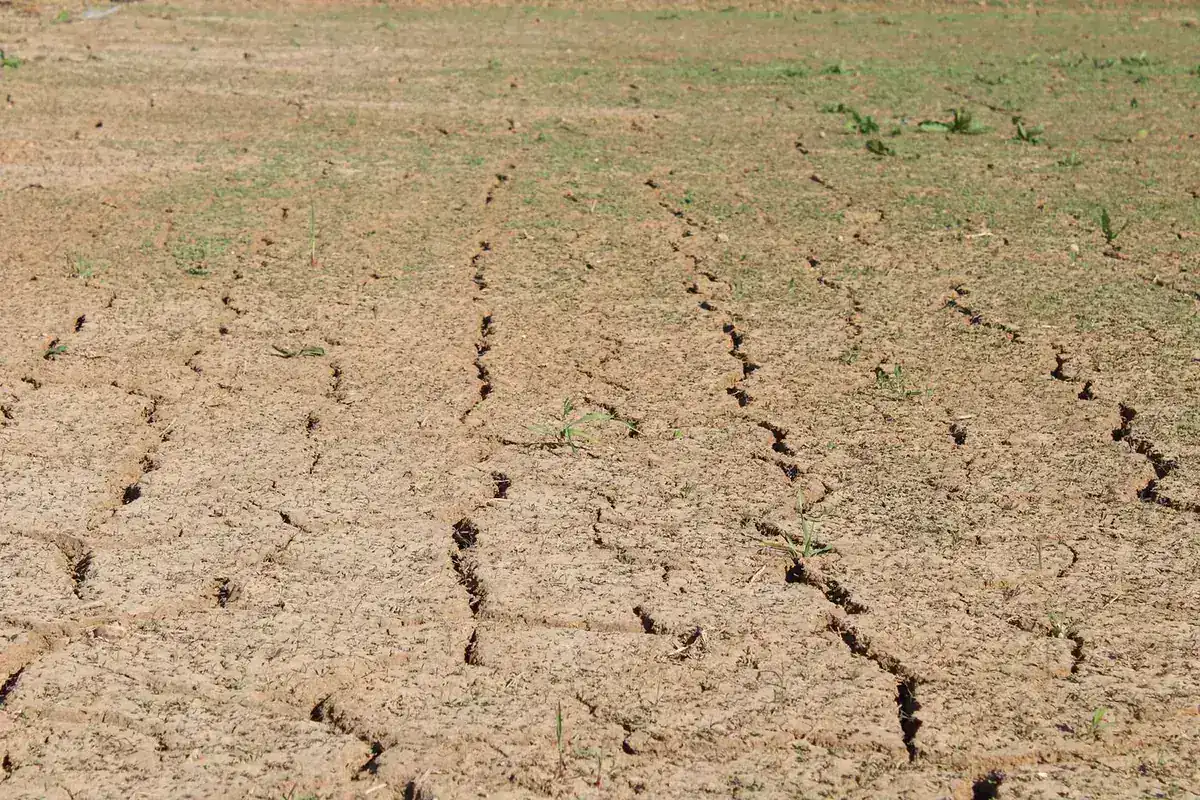
Gilgai is the hummocky ground clay builds for itself: the Beaumont description records 10 to 38 cm of difference between knolls and hollows in undisturbed ground. Cracks open in dry spells and close when the clay takes water back. And the profile is often saturated, so a site can look dry on top and be wet a shovel-length down. Each of those moves a slab: the ground rises in one place, falls away in another, and changes with the season.

How a post-tension slab deals with it
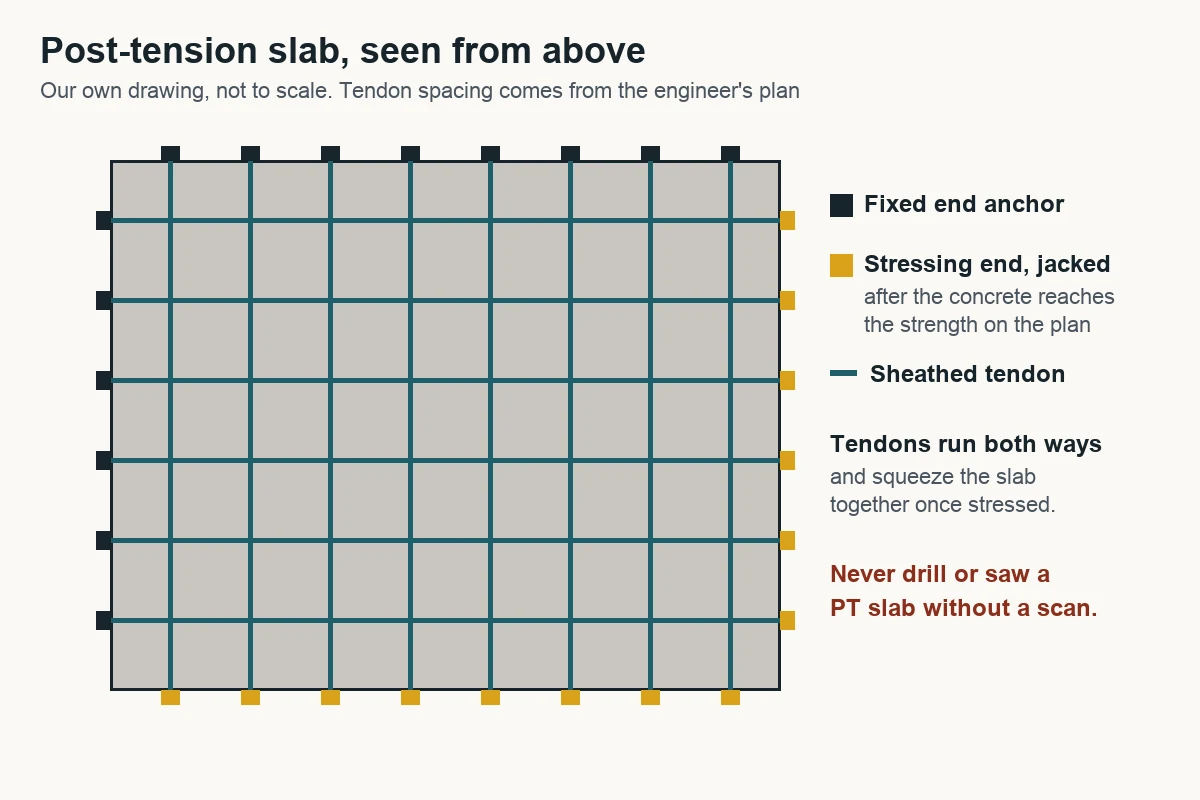
A post-tension slab has steel tendons running both ways through the slab and its beams. After the concrete gains strength, the tendons are jacked tight and locked, squeezing the slab. A compressed slab can bridge a soft spot or ride a rising edge without opening up. The Post-Tensioning Institute calls PT slabs-on-ground “a cost-efficient, high-performance solution for problems associated with ground-supported residential foundations on shrink-swell soils,” and notes they reduce or eliminate cracking and control joints. The 2024 IRC points to PTI's DC10.5-19 standard for their design.
Where PT fits and where it doesn't
| Job | Usual approach on Houston clay | Why |
|---|---|---|
| New house or addition | Post-tension, engineered | Movement cracks finishes and doors; PTI design addresses it |
| Barndominium | Post-tension or deep-beam rebar, engineered | House rules apply to the living side |
| Large shop or metal building | Engineer's call; PT on larger slabs | Fewer joints over a big floor |
| Garage slab | Rebar slab with thickened edges, or PT if engineered | Smaller span, simpler loads |
| Patio, pad, shed | Conventional rebar or mesh | A crack is a nuisance, not structural damage |
Our summary of common practice. The engineer's design governs any building foundation.
What helps any slab on Houston clay
- A soil report for any building slab; the engineer designs from it
- Drainage sorted before forms go down: water away from the slab, downspouts carried off
- Soft, saturated soil removed rather than compacted over
- Steel held up on chairs so it ends up inside the concrete
- Consistent moisture around a finished foundation; the clay moves most when it swings wet to dry
Ready to build? See post-tension slabs in Houston, slab foundations, shop slabs and barndominium slabs. Weighing a raised floor instead? Read slab on grade vs pier and beam.